The 2026 digital dining landscape demands far more than digital menus. Restaurant app development now powers sophisticated ecosystems managing food ordering, restaurant reservation systems, event booking, AI-driven personalization, real-time kitchen displays, and seamless POS integrations. For a restaurant app development company like Pixact Technologies, the challenge isn’t just building apps; it’s architecting platforms that scale across thousands of locations serving millions during peak dinner service.
This comprehensive guide breaks down scalable restaurant mobile app development architecture, with expanded deep dives into restaurant app development vs restaurant software development differences, plus battle-tested patterns for custom restaurant mobile app platforms.
Why Custom Restaurant Apps Destroy Aggregator Dependency
“Should restaurants build custom apps or use DoorDash/Uber Eats?” The math is brutal: 25-35% commissions + zero customer data ownership = slow death by margin erosion.
Custom restaurant app development delivers game-changing advantages:
- Direct Revenue: No 30% aggregator cut on every order
- Customer Ownership: Build loyalty directly, not through rented audiences
- Brand Control: Your logo, your vibe, your pricing
- Data Goldmine: Every order reveals menu preferences, peak times, and AOV patterns
- Native Integrations: Real-time POS sync eliminates double-entry chaos
Real-World ROI: Regional 15-location Italian chain launched custom restaurant mobile app, saved $2.4M/year in commissions, boosted repeat orders 38% through owned loyalty program. Advanced ecommerce mobile strategies mirror these direct-to-consumer wins.
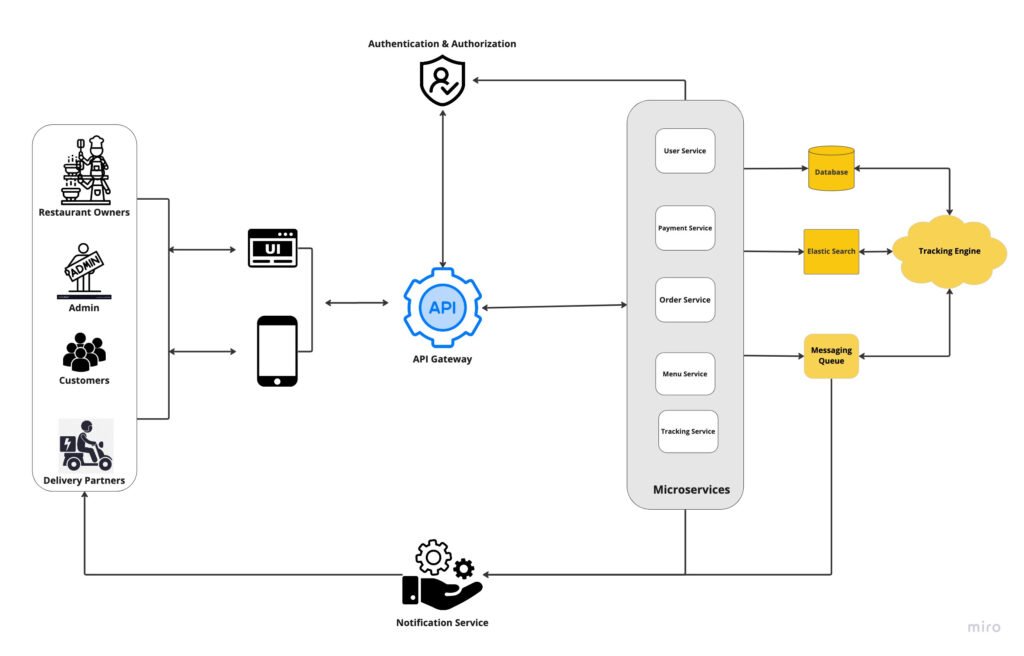
Microservices Architecture: Engineered for Dinner Rushes
Monolithic apps flatline at 6 PM Friday. Modern restaurant software development demands microservices where modules scale independently:
Production-Grade Service Breakdown:
- ORDERING-SERVICE (50% traffic): Cart → Tax → Inventory → Promo validation
- RESERVATION-SERVICE (15%): Real-time table availability → Waitlist management
- LOYALTY-SERVICE (5%): Points accrual → Tier progression → Redemption rules
- COURIER-SERVICE (20%): GPS dispatch → ETA prediction → Driver reassignment
- KITCHEN-SERVICE (8%): Order routing → Prep timers → Status broadcasting
- MERCHANT-PORTAL (2%): Analytics → Menu management → Staff scheduling
- PAYMENT-SERVICE (10%): Stripe → Apple Pay → Split payments
- Rush Hour Auto-Scaling: Kubernetes spins 25x more ORDERING instances at peak while LOYALTY sleeps. Enterprise mobile app patterns power identical scalability.
Table 1: 2026 Restaurant Platform Tech Stack
| Component | Technology | Dinner Rush Advantage |
| Mobile Frontend | React Native v0.75 / Flutter 3.22 | 70% faster development, native 120fps |
| Backend | Node.js 22 + Express | 100K concurrent connections, non-blocking |
| Primary DB | PostgreSQL 17 + TimescaleDB | ACID transactions + time-series orders |
| Cache | Redis 8.0 Cluster | <1ms menu reads for 50K simultaneous users |
| Message Queue | Kafka 3.8 / RabbitMQ 4.0 | Guaranteed order delivery, no lost tickets |
| Real-time | Socket.io 4.8 + WebRTC | Live kitchen displays, driver ETAs |
| Search | Elasticsearch 8.15 | Fuzzy menu search, “Pad Thai near me” |
| Cloud | AWS EKS / Azure AKS multi-AZ | 99.99% uptime across regions |
3-Tier Architecture: Customer → Kitchen → Analytics
Presentation Tier (restaurant app UI/UX):
📱 iOS/Android/Web → React Native shell
⚡ PWA fallback for desktop ordering
🌐 Offline-first menu browsing
🎨 Component library (100+ reusable elements)
Logic Tier (restaurant app backend development):
💳 Tax engine (multi-jurisdiction)
🛒 Dynamic inventory sync (hide sold-out)
🤖 ML personalization (“Your usual?”)
🔗 POS integration adapters (Toast/Clover)
Data Tier (Multi-temperature storage):
🔥 Hot: Redis (cart state, session data) <1ms
📊 Warm: PostgreSQL (orders, customers) <50ms
🧊 Cold: S3 + Athena (ML training, compliance) hours
Real-Time Order Pipeline: Zero Lost Tickets
1. USER: “Chicken Tikka Masala + Naan” → ORDER-SERVICE
2. INVENTORY: “12 portions left” → validates promo code
3. PAYMENT: Stripe → 3D Secure → $28.47 authorized
4. KITCHEN: WebSocket → Kitchen Display System (2s)
5. NOTIFICATION: SMS “Order #8472 accepted, prep 12min.”
6. COURIER: Auto-dispatch → Driver app GPS (3mi radius)
7. TRACKING: Live map → “Arriving in 8min (92% confidence).”
Kafka guarantees delivery even if PAYMENT-SERVICE restarts mid-transaction. Our MVP validation process proves this pipeline at scale.
POS Integration: The Operational Nervous System
“How do restaurant apps sync with POS without chaos?” Legacy systems demand intelligent adapters:
- TOAST v2 API → Kitchen Display → Thermal Printer
- CLOVER REST → Inventory Sync → Menu Updates
- ORACLE MICROS → Order Routing → Prep Timers
- SQUARE → Split Payments → Tip Distribution
Adapter Pattern Success: 28-location chain deployed across 4 POS vendors simultaneously. Kitchen received app orders within 3 seconds of checkout completion. Secure payment standards ensure PCI-DSS compliance.
Table 2: Friday 6-8 PM Performance Targets
| Load Scenario | Target Response | Production Solution |
| 15K orders/hour | Checkout <500ms | Redis Cluster + CloudFront CDN |
| Loyalty redemption | Points apply instantly | Async Kafka processing |
| Kitchen display | Order appears <2s | WebSocket + Service Workers |
| Multi-chain | Regional data routing | Multi-region read replicas |
| Search spikes | Menu search <150ms | Elasticsearch + query caching |
AI Personalization: 22% AOV Boost
Machine learning transforms “What should I order?” into “$38 average basket”:
“Pad Thai lovers also ordered Spring Rolls (87% confidence).”
“Your usual 6:15 PM table for 4? [Reserve Now].”
“Driver 2 blocks away, unlocking contactless handoff.”
“Wednesday Combo: +$2.50 Bubble Tea (limited time)”
Dual ML Pipeline: Edge TensorFlow.js (instant suggestions) + cloud retraining (weekly). AI-powered mobile trends drive these capabilities.
Expanded: Restaurant App Development vs Restaurant Software Development
Restaurant App Development (Customer-Facing)
Focus: Converting browsers to repeat orderers through flawless mobile experiences.
Core Capabilities:
🍽️ Food Ordering: One-tap reorder, bundle suggestions
📅 Restaurant Reservation: Real-time table availability
🎟️ Event Booking: Private dining, catering calendar
⭐ Loyalty Gamification: Points, tiers, birthday rewards
🛒 Dynamic Menus: Hide sold-out, weather-based suggestions
📍 Live Tracking: “Your driver turned onto Main St.”
Success Metrics:
- 45% orders via app (vs website)
- 28% AOV increase through personalization
- 60%+ repeat customer rate
- <90s average order completion
Restaurant Software Development (Operational Backbone)
Focus: Powering kitchen chaos → operational excellence during peak service.
Core Capabilities:
🔗 POS Integration: Toast/Clover/Micros adapters
👨🍳 Kitchen Display System: Real-time order tickets
📦 Inventory Management: Auto-menu updates
👥 Multi-Location Dashboard: 100+ restaurant chain
📊 Enterprise Reporting: Revenue/location, labor optimization
🔄 IoT Integration: Smart fridges, oven timers
Success Metrics:
- 98% order sync accuracy with POS
- <3s kitchen ticket delivery
- Zero duplicate entries across systems
- 99.9% uptime during dinner rush
Pixact Dual Expertise: We build both layers simultaneously, ensuring your food ordering app thrills customers while the restaurant reservation backend survives Black Friday-level volume. Most agencies specialize in one—frontend dazzle OR backend reliability. We deliver the complete digital restaurant nervous system.
Courier Management: Driverless Dispatch
On-demand delivery scales autonomously:
NEW ORDER → 5mi courier radius search (3s)
→ Real-time ETA (Google Maps + ML traffic)
→ Driver app: Navigation + photo proof-of-delivery
→ Smart reassignment (handles 12% drop-off rate)
→ Customer: Live map + “2 min away” notifications
2026 Cost Reality Check
- TEMPLATE/WHITE-LABEL: $15K-$30K (no customization)
- CUSTOM SINGLE-LOCATION: $75K-$120K (full POS sync)
- MULTI-UNIT FRANCHISE: $150K-$250K (10-50 locations)
- ENTERPRISE CHAIN: $400K-$800K+ (100+ locations)
Monthly Operating:
Hosting: $1K-$8K (auto-scales with volume)
Processing: $0.08-$0.15 per order
Support: 2-5% of dev cost annually
9-Month Implementation Roadmap
MONTHS 1-3: MVP Launch
- Menu browsing + ordering + payment
- Single restaurant POS sync (Toast/Clover)
- Basic loyalty points system
- iOS/Android React Native apps
MONTHS 4-6: Scale Phase
- Multi-location menu management
- Courier dispatch + live tracking
- Advanced ML personalization
- Reservation system v1.0
MONTHS 7-9: Enterprise Ready
- Full POS ecosystem (4+ vendors)
- Kitchen IoT displays + printers
- Multi-vendor marketplace support
- Enterprise analytics + compliance
Partner Selection: Beyond Development Agencies
Red Flags: Agencies promising “2-week restaurant apps” or lacking POS integration case studies.
Green Flags:
- Live restaurant apps with 10K+ MAU
- Multi-vendor POS integration experience
- Microservices + Kubernetes production deployments
- ML personalization driving measurable AOV lift
FAQs (AEO-Optimized)
How to build a restaurant loyalty program app?
Microservice architecture with real-time points tracking. Kafka integration ensures checkout applies discounts instantly. Gamification (tiers, streaks, referrals) boosts engagement 3x.
Native vs cross-platform restaurant app development?
React Native/Flutter: 60% faster time-to-market, native performance, single codebase maintenance. Only build native for extreme AR experiences.
Must-have features for successful restaurant apps?
1. Real-time order tracking, 2. One-tap reordering, 3. Seamless POS sync, 4. AI personalization, 5. Offline menu access, 6. Progressive web app desktop fallback.
Restaurant app development timeline 2026?
MVP (menu+ordering+POS): 12 weeks. Multi-location platform: 6 months. Enterprise chain (100+ locations): 9-12 months.
Multi-chain restaurant app scaling challenges?
Regional content routing, vendor POS standardization, menu localization, peak-hour caching. Requires enterprise mobile app development architecture from day one.
Digital Restaurant Ecosystems That Scale Globally
Scalable restaurant app architecture transforms chains from order-takers into digital orchestrators. Microservices survive dinner rushes while AI personalization drives 22% higher average order values.
Pixact Technologies combines restaurant app development +restaurant software development expertise, powering platforms from NYC startups to London chains serving 2M+ orders monthly.
Build your restaurant’s digital future. Peak dining service and peak profits await!